Seamless Displacement in OctaneRender for Cinema 4D
- Octane Render For Cinema 4d R23
- Octane Render For Cinema 4d R21
- Octane Render For Cinema 4d Free
- Octane Render For Cinema 4d R20 Crack
OctaneRender ® is the world’s first and fastest unbiased, spectrally correct GPU render engine, delivering quality and speed unrivaled by any production renderer on the market. OTOY ® is proud to advance state of the art graphics technologies with groundbreaking machine learning optimizations, out-of-core geometry support, massive 10-100x. Octane Render Playlist for Cinema 4D. David Ariew and Eyedesyn have a playlist, currently with 12 videos, that dive into Octane and Cinema 4D. The first is an overview video, then they cover topics like converting physical render scenes for Octane Render, creating a futuristic city using Octane Scatter, applying motion blur in Octane Scatter.
Seamless Displacement in OctaneRender for Cinema 4D

Hey, guys! In this blog post I’d like to share a displacement workflow which I’ve been using for quite some time now. The advantages of this approach is that we kind of bypass UVs (well, not completely true but you will see what I mean in a bit) and the notoriously nasty tears and artifacts often seen around UV seams.
Octane’s Displacement node, as I am sure you know by now, is very much UV based. However, the way we gonna do this depends on Octane’s own projection methods. This means mesh UVs and seams are gonna be of minor importance. So, here we go!
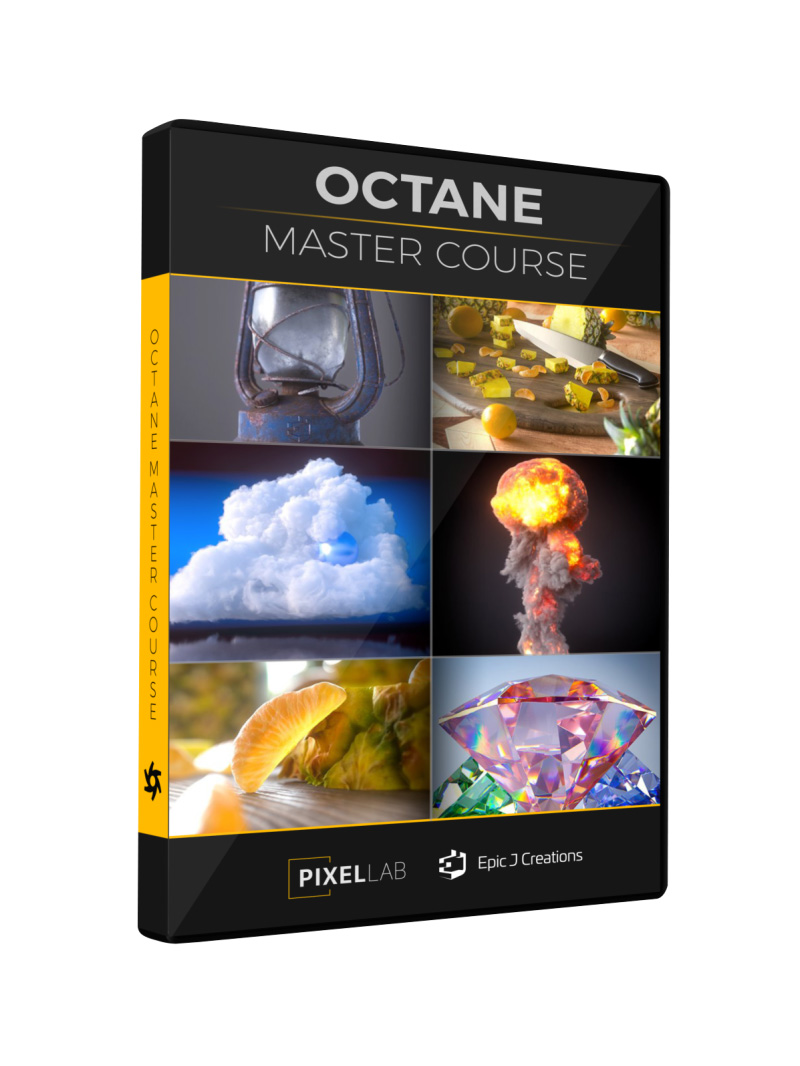
Octane Render For Cinema 4d R23
A couple of prerequisites for successful displacement – relatively even distribution of polygons and no overlapping UV islands. Both of these are common sense I guess.
Let’s start with a default, primitive sphere. No need to make it editable. As you can see, the topology here is really not gonna work for us – nasty poles on top and bottom:
Here is a better distribution of polygons. Still a primitive sphere:
Seamless Displacement OctaneRender Image 02
Let’s apply a checkerboard pattern for a quick glimpse at the UVs:
Tiling. Not good. That’s basically 6 identical UV islands, stacked on top of each other. Let’s force a spherical projection via the texture tag, applied in object manager:
Seamless Displacement OctaneRender Image 04
Okay, no more texture tiling. Not great but good enough. I will just swap the checkerboard pattern for a height map of some rocks:
So this is how it looks:
Seamless Displacement OctaneRender Image 06
Doesn’t look horrific at firs glance. Don’t be fooled though, that’s still a spherical projection – top and bottom are horrific:
Easiest way to fix this would be via a triplanar node, right? Right! However, and this is important – we are now stepping into “Octane Projections” land as the triplanar node is gonna override that spherical projection set on the texture tag. This means the Displacement shader will not be able to work with this texture – its mapping is no longer UV based! Still, we gonna do it and move forward.
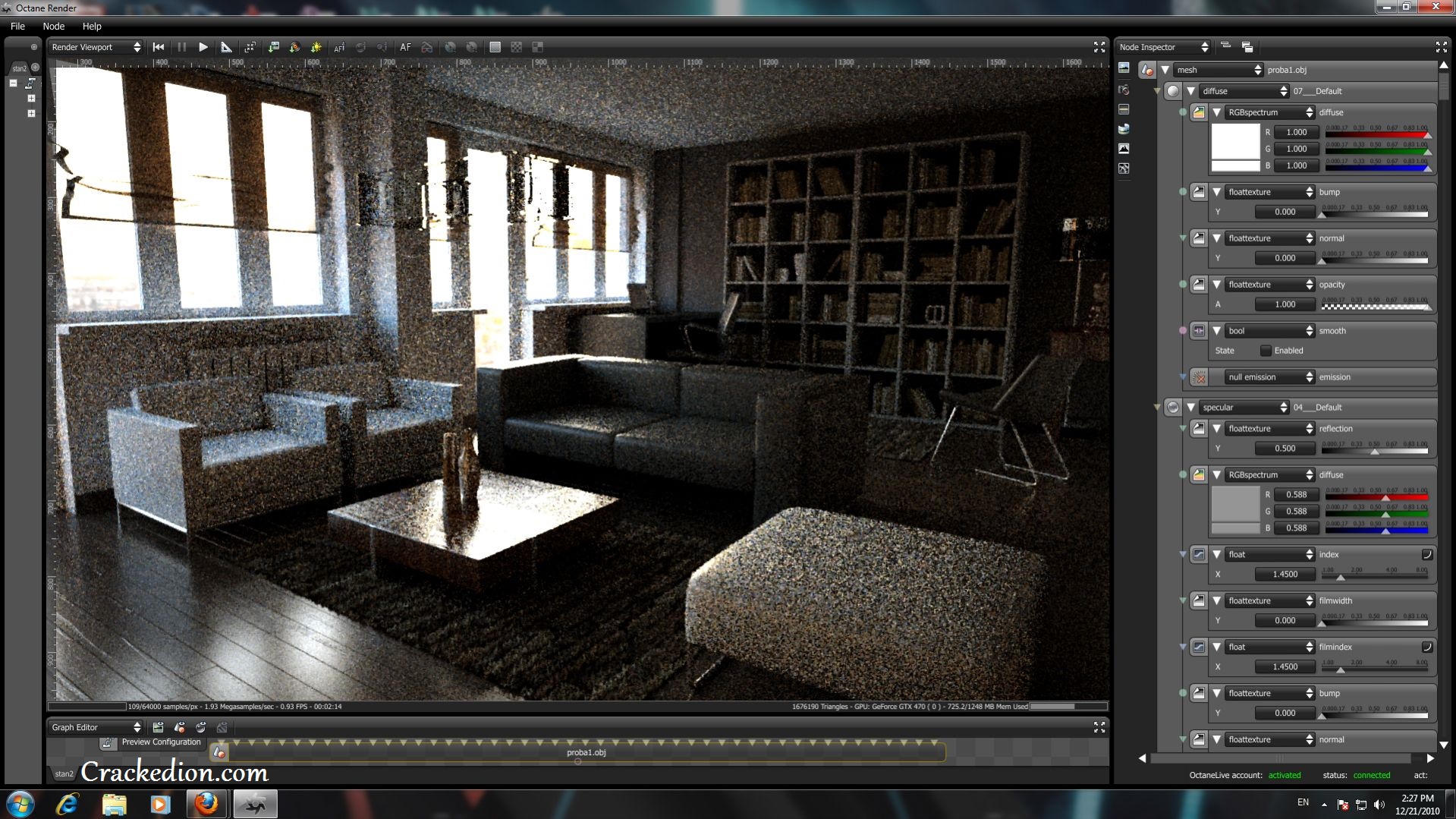
Alright, so we need to fix that bad mapping on the top and bottom. I will create a simple mask by using triplanar. Connect a float node with a value of 1 to +Y/-Y and a float set to 0 to the remaining directions. Increase the “Blend angle” some, I’ve set mine to a value of 40:
Seamless Displacement OctaneRender Image 08
You should see something like that:
Now that we have this mask, put it aside for a bit. Duplicate the rock texture and apply another triplanar node to it. Make sure you enable “Single texture” on that one. Use the mask we made as mixing factor between the original texture and the triplanar-ed duplicate. This will effectively apply triplanar mapping to the top and bottom areas only, the rest will remain as they were. See the image bellow for clarification:
Seamless Displacement OctaneRender Image 10
Looking cool in the Live Viewer:
And again, don’t bother trying to displace this, it’s not happening:
Seamless Displacement OctaneRender Image 12
So this is what we gonna do – we will use the baking features of Octane to capture the current state of the Diffuse channel. Think of it like a snapshot, of a sort. Start by adding an Octane object tag to the parametric sphere. Under “Object layer” set the “Bake ID” to 2. By default, all meshes are assigned a Bake ID of 1. In order to isolate the object we are interested in, we need a different number:
Seamless Displacement OctaneRender Image 13
Next, change the camera type to “Baking” and match that Bake ID number we just set in the Object tag:
Octane Render For Cinema 4d R21
The Live Viewer should automatically restart to render the unwrapped, baked Diffuse channel. No pinching, no stretching. How nice!:
Seamless Displacement OctaneRender Image 15
What’s left to do is save this out as a regular image texture which can easily drive the Displacement node. But wait, that’s not entirely true. If you are still looking at the image viewer, you may notice that the Diffuse channel has light information baked into it. See the obvious highlight? We need to get rid of this:
Luckily, Octane’s multi-pass system allows us to export the Diffuse channel exactly as we need it – as an albedo map, no light contribution. Enable the functionality in render settings and choose an output path, format, depth and color space. In my case I am saving out a 16 bit EXR in linear color space. “Multi-layer” file is disabled. Finally, enable the pass we are after – “Diffuse filter”:
Seamless Displacement OctaneRender Image 16
Looking at the rendered pass in the Live Viewer – things are looking much better. Nice even distribution of values:
Cool, set the desired output resolution and hit render:
Seamless Displacement OctaneRender Image 18
Once the export is complete you can change the camera type back to “Thin lens” and disable the multi-pass system. In the material editor, swap the procedural node tree for the freshly baked image texture. Mind you, my output file was a linear EXR thus the gamma parameter in the image node has been set to 1. Yours may be different:
Rendered image should remain the same:
Seamless Displacement OctaneRender Image 20
What we have now is a single texture map, that flows along the surface of the mesh. Time to turn on displacement again:
Seamless Displacement OctaneRender Image 22
Yikes! Adjusting parameters.:
Seamless Displacement OctaneRender Image 24
Oh yeah! No tears, no black artifacts. Let’s add some high-frequency noise in the Bump channel to counteract that Gaussian blur in the Displacement node:
And we are done!
Seamless Displacement in OctaneRender for Cinema 4D
Here is another example that is mixing a couple of Octane noises. No triplanar here. Projection has been set to “XYZ to UVW”. 100% clean:
Seamless Displacement in OctaneRender for Cinema 4D v02
Here’s another one, this time with a torus:
Octane Render For Cinema 4d Free
Seamless Displacement in OctaneRender for Cinema 4D v03
Thank you for reading. That’d be all! 🙂
Hey, hopefully you enjoyed this post. If you did and think that the work I do is somewhat decent, chances are you may want to join the mailing list.
I keep it clean and on topic. No spam. Just saying.
Chhota bheem himalayan adventure full movie download. Master the fundamental principles of rendering with world’s first GPU based renderer.
Covers features up to version 2.11
Note: We’ve uploaded a series of free Octane Render tutorials that greatly overlap and exceed the information contained in this product. We highly recommend checking them out before purchasing this commercial training.
Table of Contents:
01. Program Overview
Octane Render For Cinema 4d R20 Crack
– Dialog Panel
– Live Viewer
– Octane Settings
02. Materials
– Creating Materials
– Diffuse
– Glossy
– Specular
– Mix
– Portals
03. Shaders
– Overview
– Color and Spectrum
– Glossy
– Image Texture
– Generators
– Mappings
– Special
– Native Shaders
– Transform – Free Sample
– Projection
– Mediums
– Displacement
04. Live Data Base
05. Lighting
– Overview
– Texture Environment
– HDRI Environment
– Daylight
– Mesh Emission
– Volume Emission
– Light Tag
– Distribution
– Efficiency
– Visibility
06. Object Tag
07. Camera
Zuma deluxe mojave. – Thin Lens
– Imager
– Post Processing
08. Motion Blur
– Camera Motion Blur
– Object Motion Blur
– Vertex Motion Blur
– Rendering Motion Blur
09. Rendering Hair
10. Render Settings
– Direct Lighting – Free Sample
– Path Tracing & PMC
– Info Channels
– Other
11. Rendering Animation
12. Bonus – Trailer Project File
01. Program Overview – Dialog Panel, Live Viewer, Octane Settings
02. Materials – Creating Materials, Diffuse, Glossy, Specular, Mix, Portal
03. Shaders – Overview, Color and Spectrum, Image Texture, Generators, Mappings, Special, Native Shaders, Transform, Projection, Mediums, Displacement
05. Lighting – Overview, Texture Environment, HDRI Environment, Daylight, Mesh Emission, Volume Emission, Light Tag, Distribution, Efficiency, Visibility
07. Camera – Thin Lens, Imager, Post Processing
08. Motion Blur – Camera Motion Blur, Object Motion Blur, Vertex Motion Blur, Rendering
10. Render Settings – Direct Lighting, Path Tracing, PMC, Info Channels, Other
12. Bonus – Trailer Project File
Hey, hopefully you enjoyed this post. If you did and think that the work I do is somewhat decent, chances are you may want to join the mailing list.
I keep it clean and on topic. No spam. Just saying.