- Garageband Not Working On Macbook Air
- Garageband Not Responding On Mac
- Garageband Not Working On My Iphone
Presently, the maximum length of a ringtone is 30 seconds. For Andrew’s problem, before importing a song, click the small + icon beneath the setting icon in the top right of GarageBand screen, followed by pop-up small screen Section A; then, adjust the numerical number from 8 to whatever number that is large enough to cover the total length of your song ( 1 numerical number = 2 seconds. Click to expand. Go into Prefences under Garageband then click on the Audio/Midi tab.Check what you audio output is,Perhaps it was set to the Yahama Audiogram 6.Marageband did this to me when i hooked up mu Apogee One,I now have my audio output set to System Setting,Being that i switch between the speakers and the One's output.
- :/ then can you post the entire text of the crash report, rather than a picture of it - see if someone can get a hint as to what's failing. Pro Tip: Edit your question & paste the text - then select all the report text & hit Ctrl/K which will format it as code.
- Question: Q: garage band not responding Hello, I have been trying to get into my garageband for the past couple of days, it 'initializes' and then a prompt comes up saying that the application quit unexpectedly, but no other applications are affected.
There is a very simple reason for why you can’t hear what you’re recording while using Garageband, and barring more obvious reasons like a muted track or the volume turned down, there is usually a simple solution related to either the monitoring button or in Garageband’s Preferences.
You can’t hear while recording in Garageband because your Monitoring button hasn’t been turned on in the Smart Controls or on the track header. Another reason could be that your Input/Output settings haven’t been set up properly in Garageband’s Preferences.
To turn on the Monitoring button:
1) Make sure that you’ve selected the track.
2) Go down into the Smart Controls of the track you want to monitor, and click on the little monitoring button that looks like an upside-down Wi-Fi symbol. It will turn a dark-orange color once it’s turned on.
That’s all you have to do, however, in the case of this not working, there are some other things you can try as well. If you’ve set up your rig, and you can’t still hear what you’re recording for whatever reason, you can also select the “Input” and ensure that your audio interface is the input. Additionally, you can go into the Preferences as well.
by the way, I have a list of all the best products for music production on my recommended products page, including the best deals, coupon codes, and bundles, that way you don’t miss out (you’d be surprised what kind of deals are always going on).
If you still can’t hear while recording after you’ve turned on the monitoring button, go into the Audio/MIDI section in Garageband’s Preferences, then choose your audio-interface or microphone for the “Input Device.” Then, choose “Built-in Output” as your Output Device.
It’s worth mentioning that if your production has a lot of audio tracks, it’s a good practice to go back through and turn off the monitoring buttons on each one that’s currently not in use.
As I’ve explained before in my latency article, for some people, this is the difference between having latency or not, however, another issue could be that your computer isn’t powerful enough, and in that case I would recommend this maxed out 2019 model from Amazon instead.
At this stage, you should already have this problem worked through because, for most people, it’s just a matter of clicking the button. However, assuming that you’re continuing to have issues, there are a few more things you could try.
System Preferences Method
1) Go into your computer’s System Preferences in the bottom toolbar at the bottom of the computer screen.
2) Select “Input,” and choose internal microphone or whatever instrument you’re using to record.
3) Select “Output,” and select “Internal Speakers” or whatever speaker that you’re using. Smoking dragon dqh plus user manual.
You also want to make sure that you’ve turned up the volume of both the Input volume as well as the Output volume. Moreover, I like to have the Recording Level on Automatic as well. Obviously, it’s important to be able to hear yourself, especially if you’re laying down a vocal track (by the way, you should be taking Singorama to improve your vocal chops).
It’s also important to make sure that you’ve actually highlighted the track you want to play in. I discuss what this means later in the article.
How Do I Enable Microphone In Garageband
The microphone that I’ve been using is a Zoom H2 which is a very old piece of equipment. I think it’s around 10-11 years old now, however, I use it as a microphone all of the time because it still works. (The Zoom H6 from Amazon is a much better option these days if you need a mic for recording outside your studio).
How you plug it in and set it up, depends on what kind of microphone you’re using.
If you have a Zoom H2 as your primary mic, then you’ll just have a Micro USB to a USB port and you connect it into your computer that way.
However, if you have a standard mic like the Shure SM58, you’ll need a proper audio interface like a Focusrite Scarlett 2i2 from Amazon which you can read more about in my article here on The Definitive Guide To Audio Interfaces.
In the case of my Zoom H2, with Garageband open, I just plug the unit into the computer and it immediately recognizes it after I’ve turned the Zoom H2 into an Audio Interface within its settings.
At that point, Garageband will bring up a prompt asking if I’d like to use it as my recording device, rather than the computer’s internal speakers.
Whenever you need to switch your input settings, the control for how you’re feeding the signal into your computer, Preferences > Audio/MIDI > and then Input/Output Devices is where you need to be.
Moreover, assuming that you’re not using some kind of bizarre microphone, Garageband should have no problem recognizing every piece of equipment you plug into it.
If you are having some issues with this, try turning Garageband on and off again with the microphone plugged in.

Assuming that all of your settings are where they need to be, you should have no problem simply opening up the software and using the computer’s internal microphone to begin recording audio.
While it’s definitely not the best audio in the world, you can actually make it sound somewhat decent with a compressor and an EQ.
To start recording, just hit the (Option + Command + A) function on your keyboard to bring up a new audio track, and then hit the record button. Start talking to your computer and you’ll see that it’s recording.
How Do I Unmute In Garageband
To unmute a track, it’s as simple as clicking on the little icon that looks like a loudspeaker on the left-hand side of each Track Region. It turns a turquoise color if it’s on, and it’s just the regular grey color when the function is off.
It’s worth mentioning that you can actually use your cursor, and drag the cursor across the page and unmute or mute every single button on every track region just by dragging it across the screen.
It can work for turning it on or off. Make sure to check out the YouTube video below to see what I mean.
How Do I Connect Headphones Into Garageband
To connect your headphones, it really is just as simple as connecting your headphones into its headphone jack. If you have the latest MacBook Pro, the headphone jack is on the right-hand side near the screen.
In Garageband’s Preferences, I always have it set at the setting, “(Temporarily Using Built-In Output).”
In the System Preferences, I always have the Output set at Internal Speakers and Built-In.
Having a good pair of headphones for mixing and mastering is important for a number of reasons, which I explained in my review of the Audio Technica ATX-M50x.
Does Garageband Work With BlueTooth
Bluetooth does work in Garageband, however, I don’t recommend it all due to the various latency issues that you’ll run into, however, if you do choose to go that route, Audio Technica’s ATH-M50xBT from Amazon are a great option because you can switch between Bluetooth and wired connection.
Regarding Bluetooth, especially in the case of using a MIDI Keyboard, if you’ve set up your computer with Bluetooth Speakers or Bluetooth Headphones, you’ll notice that whenever you play a note on your MIDI Keyboard or your guitar, there will be a short delay time between the notes, which is obviously super annoying and it hardly makes it worth it.
Frankly, while BlueTooth technology is getting better all of the time, I still wouldn’t mess around with it when it comes to music production. It’s fine for the casual listener, but if you’re making music, BlueTooth headphones and speakers are just annoying and not worth the effort unless you get the ATH-M50xBT’s which have both kinds of connectivity.
How Do I Listen To My Guitar In Garageband While Recording
Like it was explained above and in my guide on how to connect your guitar, make sure that you’ve turned on the Monitoring button, which will turn an Orange-ish/Yellow color when the function is working.
Moreover, don’t have every monitoring button turned on, only the one that you want to listen too.
It’s worth mentioning though, that if you don’t have the track highlighted that you want to hear when you play the guitar or record vocals, it won’t actually make any sound.
Regardless of whether or not you have the Monitoring button turned on, if the track isn’t highlighted properly, it won’t actually play through that track that you’ve set up, so make sure you’ve selected it.
YouTube Video Tutorial
Conclusion
I hope this article was helpful to you. If it was, do me a solid favor and share it with your friends on social media. Thanks a lot.
GarageBand has been a breakthrough for aspiring Mac musicians. Thanks to its simplified interface and hard-to-beat price ($49 with Apple’s iLife ’04 suite), even novices can start recording digital masterpieces. But things can go wrong in GarageBand—missing loops, silent instruments, and so on. Here are some recipes for solving the most-common GarageBand problems.
Your Loop Browser Is Empty
Adding loops to GarageBand isn’t just a matter of stuffing them into a folder on your hard drive. You also have to make GarageBand aware of them. To do that, you must force GarageBand to index new loops, thereby building an internal card catalog of the loops and their locations.
Garageband Not Working On Macbook Air
If anything goes wrong with GarageBand’s loop index, you may discover that all the buttons in the Loop browser are dimmed and no loops appear in its list. Some loops may exist in name only.
In these situations, the solution is to rebuild the GarageBand loop index.
Step 1 Quit GarageBand. In the Finder, open your hard drive and go to Library: Application Support: GarageBand: Apple Loops. Inside, you’ll see the text files that constitute your current index. Drag these files to the Trash.
Step 2 Restart GarageBand and click on the Loop Browser button (which looks like an eye). GarageBand will display the No Apple Loops Found dialog box. Click on OK and return to the Finder.
Step 3 Open your hard drive and go to Library: Application Support: GarageBand. Drag the Apple Loops folder from the GarageBand folder into any visible portion of GarageBand’s Loop browser. GarageBand will dutifully re-create its loop index, based on the current location and contents of that Loops folder.
Step 4 If you’ve installed the Jam Pack, drag its folder (also in Library: Application Support: GarageBand) into the Loop browser, too.
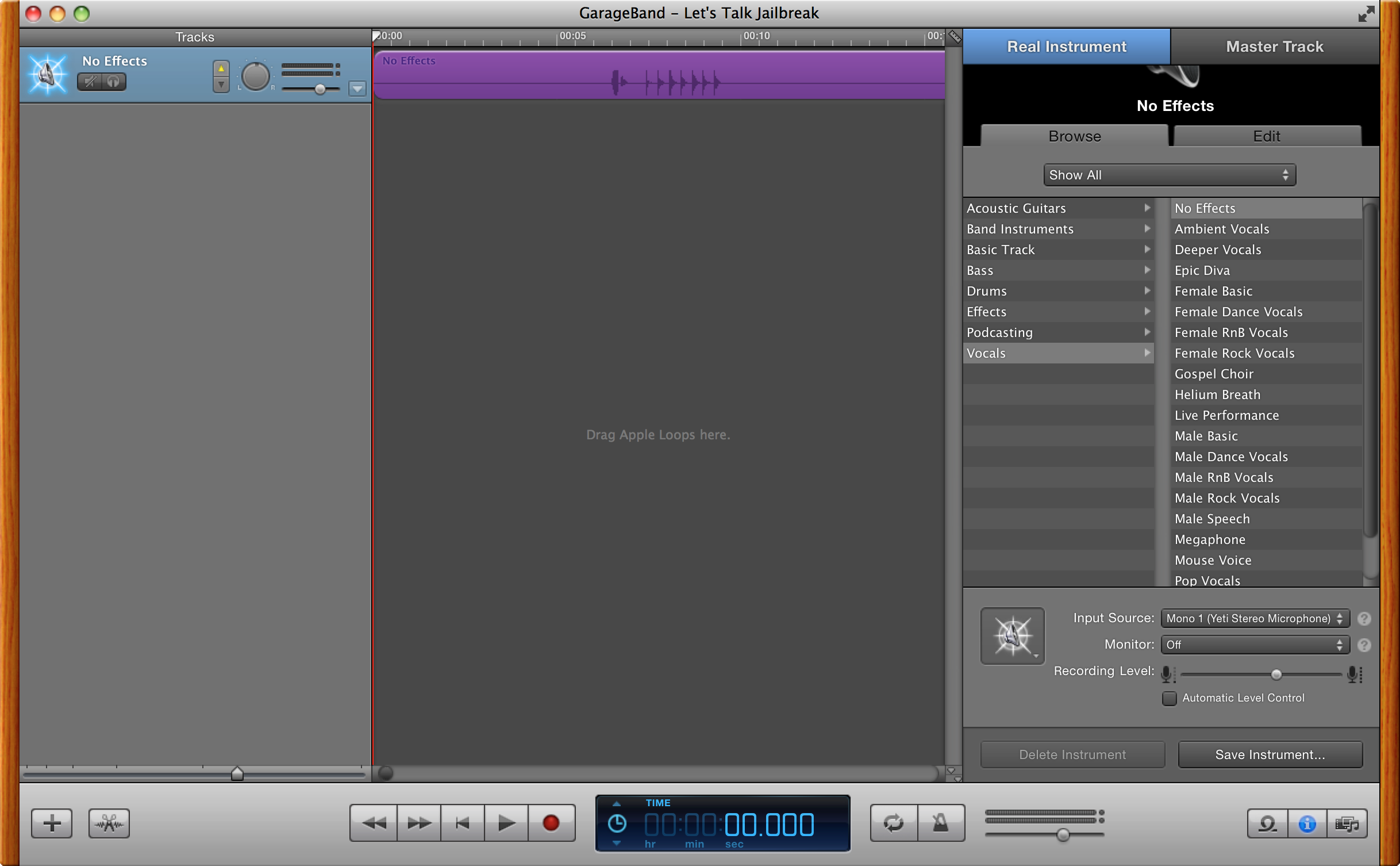
No Sound from a Mike or a Real Instrument
If GarageBand doesn’t seem to be “hearing” anything from your microphone or line input, the Mac probably hasn’t been taught to listen to the right audio source. Open OS X’s Sound preference pane and click on the Input tab. Select the sound source you want to record, and then adjust the Input Volume slider for your singing or playing. (The loudest notes should briefly illuminate the rightmost bars.) Return to GarageBand and open its Audio/MIDI preferences. Click on the Audio Input pop-up menu and make sure that the correct input is selected.
If the problem persists, try these steps:
Step 1 Make sure that you’re working with a blue Real Instrument track. Rabbit hx 720 drivers. If a green Software Instrument track is selected, GarageBand ignores your microphone or instrument.
Step 2 Make sure that you haven’t muted this track or soloed another one. (The speaker icon in your track’s header should be blue, but no other instrument’s headphones icon should be lit up.) While you’re at it, make sure the track’s volume slider isn’t set to zero.
Step 3 GarageBand may be set up to listen to the wrong channel. Double-click on the track header and examine the Input pop-up menu and Format (Mono/Stereo) settings.
Step 4 If you’re using a mixer or an audio interface, make sure that its volume is turned all the way down.
Step 5 Check whether you’re hearing any sound from the instrument. If it’s electric, make sure that it’s turned on, with the volume turned up. Also make sure all the connections are good—especially if you’ve incorporated plug adapters into the mix.
Step 6 If you’re using a Griffin iMic adapter, make sure that you’ve connected the mike or instrument to the iMic’s input jack (the one with a microphone symbol). Also be sure to switch the iMic’s selector toward the microphone symbol. Open GarageBand’s Audio/MIDI preferences and choose iMic USB Audio System from the Audio Input pop-up menu.
No Sound from a MIDI Instrument
Having trouble getting GarageBand to hear an external MIDI instrument, such as a keyboard controller or a MIDI guitar? If so, your MIDI status light can help you identify the culprit.
Status Light Doesn’t Respond If the MIDI status light doesn’t flicker when you play, MIDI information may not be reaching GarageBand. Make sure that the instrument is turned on and connected to the Mac.
Garageband Not Responding On Mac
If a MIDI interface box is involved, double-check your connections. It’s very easy to get the MIDI In and MIDI Out cables confused.
Open GarageBand’s Audio/MIDI preferences. The MIDI Status line should read “1 MIDI Input(s) Detected” (or however many instruments you have connected). If it doesn’t, your MIDI interface may require its own driver software. Visit the manufacturer’s Web site to seek out an OS X-compatible driver.
Status Light Does Respond If the indicator does flicker on and off, then everything is correctly hooked up. In that case, make sure that you’ve selected a green Software Instrument track. Also check that you haven’t muted this track or soloed another one.

If you still encounter the problem, go to Window: Keyboard to open the on-screen keyboard. Click on a few keys to ensure that the selected track has a working instrument selected. You might also try double-clicking on the track header to open the Track Info dialog box. You should have an instrument and effects preset active in the top two lists. In the Details panel, try turning off your effects one by one until you find the problem. (It’s possible to fiddle with the effects so much that no sound emerges.)
Finally, check whether you, in fact, have any Software Instruments available. Double-click on a track header to see if anything is in the list. If you or somebody else has been doing some naughty playing in the Library: Application Support: GarageBand folder, the files may be so dismantled that you need to reinstall GarageBand to get it going again.
No Sound from External Speakers
Ordinarily, GarageBand plays back sounds through your Mac’s audio circuitry—either through your Mac’s built-in speakers or through speakers connected to its headphone jack. But what if you’ve bought fancy USB speakers? Or what if you’ve connected an audio interface box that’s hooked up to its own sound system? In those cases, you’ll need to adjust your audio options. Open GarageBand’s Audio/MIDI preferences. Click on the Audio Input Driver pop-up menu to select the name of your external speakers or interface box. If you don’t see it listed, you may need to install the appropriate driver—this usually comes with the speakers or audio box.
Panned Tracks Still Play in Both Speakers
In GarageBand, you can use the Pan knob to place a certain track’s instrument all the way to the left or right side of the stereo field. If you do this but still hear the darned thing coming out of both speakers, there are two possible explanations.
The likeliest culprit is an Echo or Reverb effect that you’ve applied to that track. When you select these options for an individual track, you’re not really applying a different echo or reverb to the track. Instead, you’re telling GarageBand how much of the master track’s echo and reverb to apply. As a result, you’ll hear your fully panned track reverberating through both speakers, courtesy of the master echo or reverb. The solution, then, is to turn off the panned track’s Echo and/or Reverb effect. Double-click on its track header, and deselect the corresponding options.
This problem can also occur if you’ve used the Compressor effect. Turning on Compressor for the master track forces all tracks to play in both the left and the right channels. To solve the problem, turn off the master track’s Compressor effect. (Turning off Compressor for an individual track won’t make a difference.)
[ This article is an excerpt from GarageBand: The Missing Manual , by David Pogue (2004; reprinted by permission of O’Reilly Media. ]
If you’re having loop problems, trash your old loop index files.